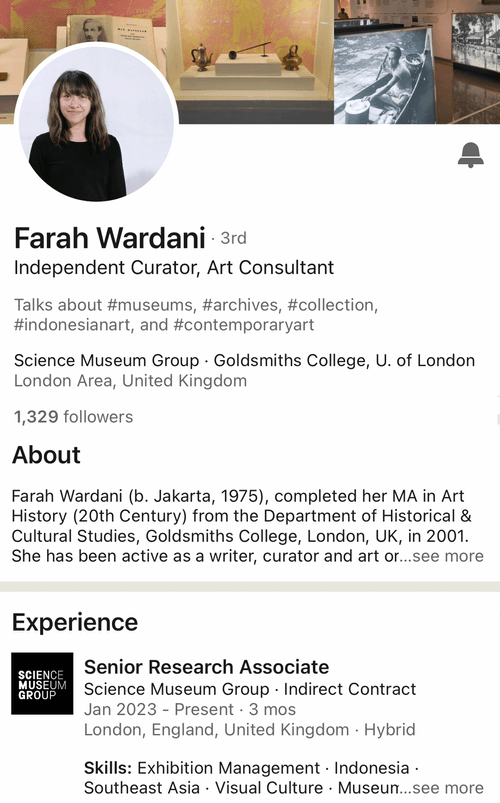
For Farah Wardani, the path to becoming a leading curator and art historian wasn't a straight line. Growing up in 1980s Jakarta, her passion for painting and drawing was evident, but the local art scene was not the robust ecosystem it is today.
Navigating family concerns about the viability of an art career, Farah struck a compromise: she pursued Graphic Design at Trisakti University. However, the pull of the arts was undeniable. Her academic excellence eventually led her to Goldsmiths University in London, where a Master’s in Art History revealed her true calling: not just making art, but understanding, curating, and writing about it.
Upon returning to Jakarta in 2001, Farah knew that to break into the industry, she needed a network. She traveled to Yogyakarta, immersing herself in the scene at the Cemeti Art Institute. She describes this period as living a 'hippie lifestyle,' bouncing between Jakarta and Yogyakarta before joining the influential ruangrupa artist collective.
It was here that she embraced the 'classic Southeast Asian way' of entering the art world - a DIY approach where practitioners bypassed formal institutions to create their own platforms. This led to her first major curatorial success in 2003: Girl Talk, a show commemorating women’s rituals that featured renowned artists like Dolorosa Sinaga.
While curating was a passion, preservation became her mission. In 2006, Farah moved to Yogyakarta to build the Indonesian Visual Arts Archive (IVAA).
She devoted herself to the cultural sector, constructing an archival library that would establish a system of knowledge distribution. By 2012, she had developed an Indonesian Archive Network, creating databases for indigenous communities and governmental institutions to ensure that the history of Indonesian art was not just remembered, but accessible to the public.
—
From the 2008 Art Boom to the Jakarta Biennale
How did Farah navigate the explosion of the Indonesian art market, and what are her thoughts on the 'myth' of the curator? To read the full feature on her work with the National Gallery of Singapore and her current projects in London, check out LIMINALITY, the 2nd volume of INTERLUNAR’s zine.