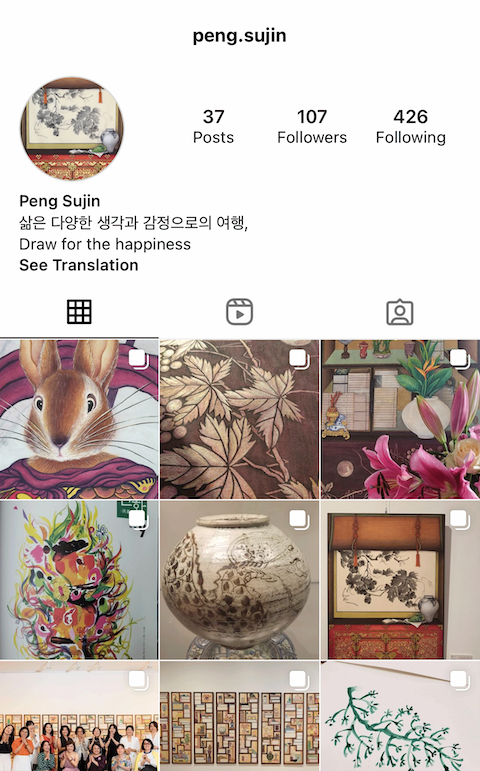
For Korean visual artist Peng Su Jin, art is a dialogue between two worlds. Having lived in Singapore for the past sixteen years, she has developed a unique artistic lens that merges her East Asian heritage with the vibrant culture of Southeast Asia.
Currently working as a docent at the Asian Civilisations Museum (ACM), Su Jin embraces this duality by incorporating local fauna into traditional forms, creating a visual language that honors both her roots and her new home.
Her most poignant exploration of this theme is found in her Grapevine Series, specifically Landscape with Grapes I and II. These works are deeply inspired by the poem Green Grapes by Yi Yuksa, a Korean poet and independence activist who wrote during the Japanese colonial era.
For Su Jin, the grapes represent a fighting spirit. She translates Yi’s poetry onto the canvas using a deliberate color palette: ample red to embody the nation’s collective sorrow and soul, contrasted with gold paint to represent hope, love, and optimism.
In Landscape with Grapes II, Su Jin creates a visual history of her own life. A white Moon Jar sits on a shelf, representing Korea’s collective history. Yet, extending out of this traditional vessel are Birds of Paradise flowers - symbols of her new roots in Singapore.
By placing these tropical flowers in equal regard to Minhwa (the Korean folk art style she paints), she creates a harmony between her past and present.
—
Want to learn about her traditional techniques?
From her award-winning Auspicious Valley to her unique process of using traditional Hanji paper and animal gelatin glue, there is much more to uncover about Su Jin’s craft. To read the full feature and learn about her distinct 'Minhwa' style, check out LIMINALITY, the 2nd volume of INTERLUNAR’s zine.