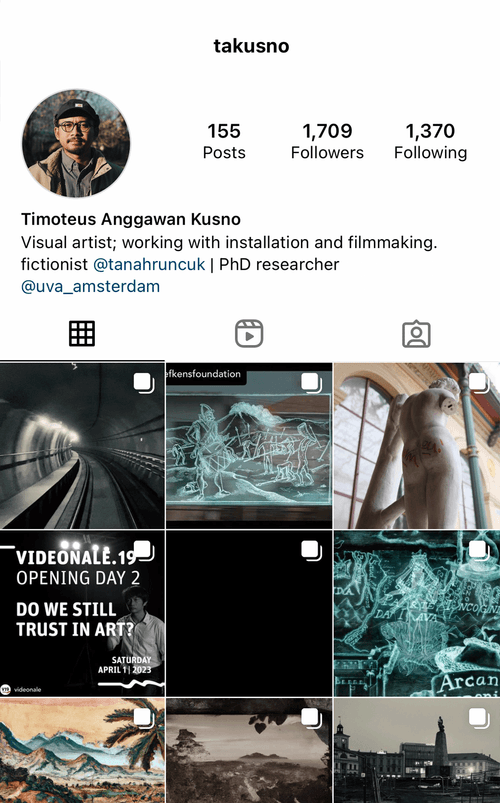
Timoteus Anggawan Kusno (Angga) is not an artist who sits idle waiting for inspiration. Working across filmmaking, production, and installation, Angga treats his art as a form of research. For him, the creative process is a journey of asking introspective questions, collecting audiovisual footage, and using illustration as a way to digest foreign stimuli.
To capture the world as he sees it, Angga has a strict set of non-negotiables. He never travels without an iPad, a notebook, a laptop, and his two cameras (a Fujifilm X100V and a Sony A7s III).
He believes that while distance is necessary to process thoughts, being close to a subject is vital to fully experience a phenomenon. 'Flexibility is key in the field,' he says. When the heavy gear isn't practical, he resorts to his phone, capturing raw, organic, and improvised footage that reflects exactly what he sees in the moment.
Angga’s roots in the visual arts run deep. His fascination began in his youth, watching his father develop analogue film in a home darkroom. This early exposure led him to high school photography clubs and eventually the Jogja Art Festival, where the overwhelming feedback hooked him on the world of exhibitions.
However, despite his success in Java's epicenter of contemporary art, Angga has no formal art training. He studied Communication Studies at Universitas Gadjah Mada, focusing on journalism and political science. Instead of an art academy, he learned from the masters of the Jogja art scene. He embraced nongkrong, or the Indonesian concept of sharing space without a pre-defined purpose. By 'studying in the streets' and exchanging thoughts with directors, painters, and performers, Angga's craft grew organically.
—
History, Colonialism, and the Buru Quartet
How does an artist without formal training end up working with the Rijksmuseum to examine looted colonial artifacts? To understand Angga’s deep connection to Indonesian literature and his deconstruction of colonial history, read the full feature in LIMINALITY, the 2nd volume of INTERLUNAR’s zine.